
Stop 3 of 58, Europe
Stockholm
Sweden · The Nordics
Stockholm stretches across fourteen islands where Lake Mälaren flows into the Baltic Sea. Its old town, Gamla stan, was built from the 13th century on. About a third of the city is water, and almost another third is parks and green spaces.
- Country
- Sweden
- Region
- The Nordics
- People
- about 1 million
- Islands
- 14
Try a Stockholm question
Where is the island of Gotland?
The tour starts in Reykjavík.
A short history
Stockholm was founded as a city in 1252 by the statesman Birger Jarl. A charter from 1436 is seen as the start of its role as the de facto capital of Sweden. In 1634 it became the official capital of the Swedish empire. Today the city itself has just under one million residents. The urban area has about 1.6 million, and the wider metro area about 2.5 million.
Worth seeing
The warship Vasa sank on her first voyage on 10 August 1628, after sailing only about 1,300 metres. She lay on the seabed for 333 years, until she was raised in 1961. Now she sits in the Vasa Museum, which opened in 1990 and is the most visited museum in Scandinavia.
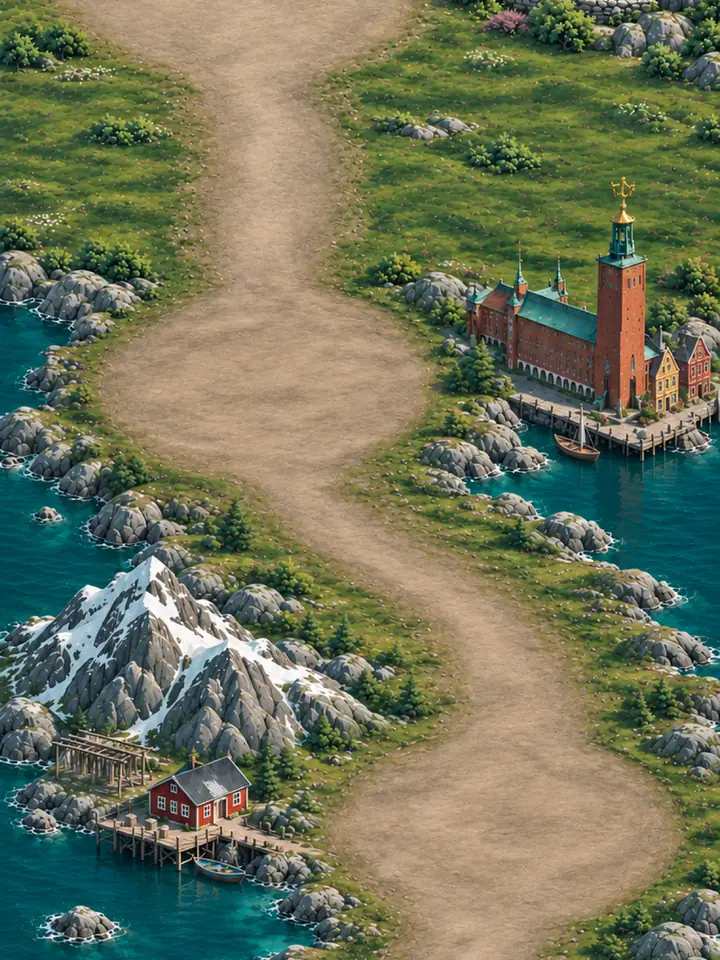
Stockholm City Hall is another place to know. Together with the Concert Hall, it hosts the Nobel Prize ceremonies and banquet every year.
Did you know?
- The Stockholm Metro opened in 1950 and has been called the longest art gallery in the world.
- Lake Mälaren, which flows out here, is Sweden’s third-largest lake.
- Divers made more than 1,300 dives to raise the Vasa, without serious accidents.
Find it on the map
Look at Sweden’s east coast, at about 59 degrees north. Stockholm sits where freshwater Lake Mälaren, Sweden’s third-largest lake, flows out into the Baltic Sea. East of the city, along the coast, the Stockholm archipelago spreads out as a long chain of islands.