
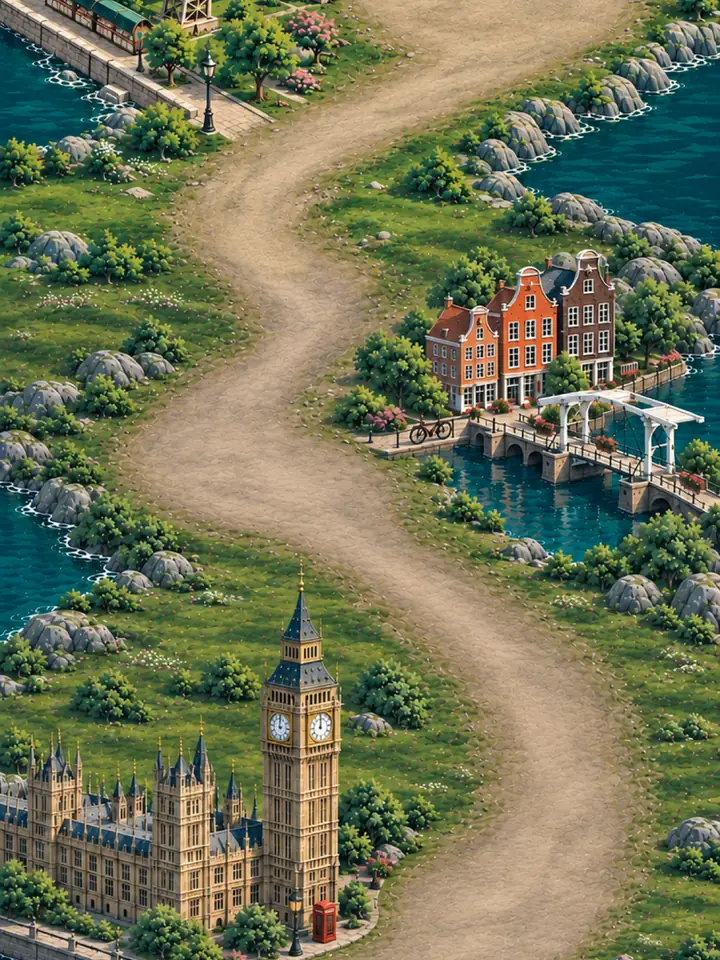
Stop 6 of 58, Europe
Amsterdam
Netherlands · Western Europe
Amsterdam’s name means “dam in the Amstel”, after the dam built on the river to hold back floods. Its ring of 17th-century canals has been a UNESCO World Heritage Site since 2010. The old Royal Palace stands on 13,659 wooden piles. Cycling is part of everyday life here.
- Country
- Netherlands
- Region
- Western Europe
- Canal ring
- UNESCO since 2010
- Royal Palace
- 13,659 wooden piles
Try a Amsterdam question
Where does the Afsluitdijk dam off the Zuiderzee?
The tour starts in Reykjavík.
A short history
In either 1300 or 1306 the bishop of Utrecht granted the settlement special rights. A great flood in 1170 had already turned the shallow IJ into a wide estuary. In the 17th century, the Golden Age, Amsterdam became the wealthiest city in the Western world. Three main canals date from that time: the Herengracht, the Keizersgracht and the Prinsengracht. Amsterdam is the capital of the Netherlands, but the government sits in The Hague.
Worth seeing
Walk along the three main canals, Herengracht, Keizersgracht and Prinsengracht, and you follow the 17th-century canal ring. It lies inside a waterway called the Singelgracht. The ring is protected as a UNESCO World Heritage Site.
Dam Square holds the Royal Palace and the former city hall. The Rijksmuseum, a state museum, shows art from the Dutch Golden Age. The Van Gogh Museum and the Anne Frank House are among the city’s main attractions too.
Did you know?
- Amsterdam has more than 100 km of canals.
- The city is divided into about 90 islands, linked by more than 1,200 bridges.
- Its elevation is about 2 metres below sea level.
Find it on the map
Look at the western Netherlands, in the province of North Holland. The provincial capital is Haarlem, not Amsterdam. The Amstel river ends in the city centre, and its canals run into the IJ. The North Sea Canal connects the city to the North Sea.