
Stop 10 of 58, Europe
Lisbon
Portugal · Iberia & the Mediterranean
Lisbon lies at the mouth of the Tagus, where the river empties into the Atlantic. The earthquake of 1755 destroyed about 85 percent of the city’s buildings. The Baixa was rebuilt on a neat grid, and on the hills, some streets can only be climbed by small trams.
- Country
- Portugal
- Region
- Iberia & the Mediterranean
- River
- Tagus
- Rebuilt
- After the 1755 quake
Try a Lisbon question
Where is mainland Europe’s most westerly point?
The tour starts in Reykjavík.
A short history
Lisbon began as Olisipo. Julius Caesar made it a municipium and added the name Felicitas Julia. The Moors captured the city in the 8th century, and Afonso Henriques won it back in 1147. In the 13th century it replaced Coimbra as the capital of Portugal. Most Portuguese expeditions of the Age of Discovery set out from here, including Vasco da Gama’s voyage to India in 1498.
Worth seeing
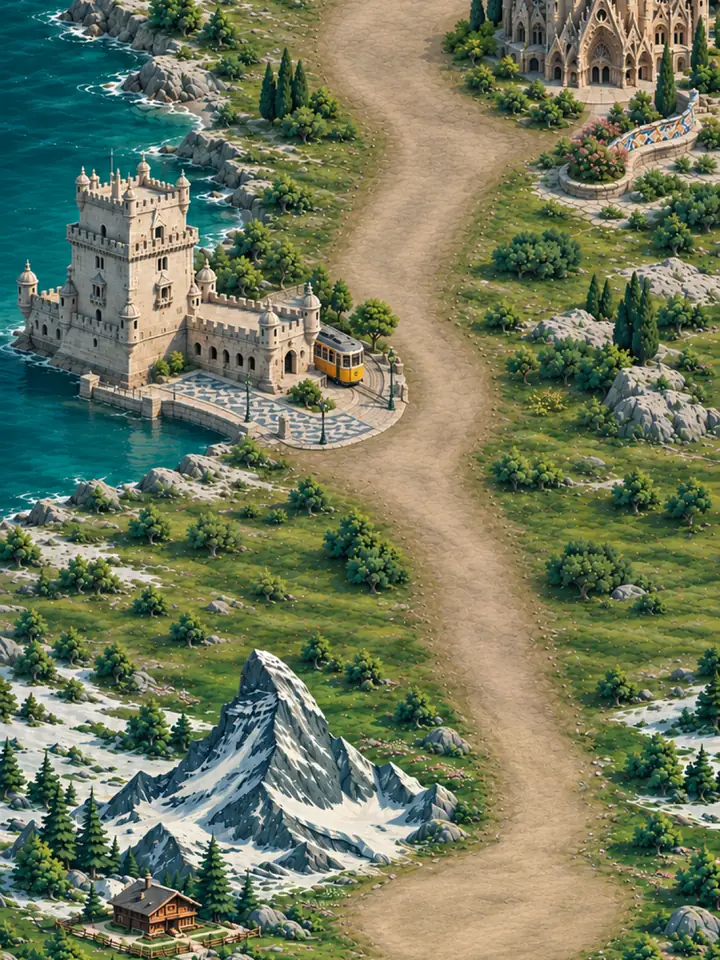
Belém Tower guarded the mouth of the Tagus. Military architect Francisco de Arruda designed it, and it was finished in 1519. It is built from lioz, a beige-white limestone from the Lisbon area. On the bases of its turrets you can spot a carved rhinoceros, perhaps the one Manuel I sent to the Pope in 1515. The tower and the Jerónimos Monastery became UNESCO sites in 1983.
The Alfama is the oldest existing district of Lisbon. In the west, the Monsanto Forest Park covers about 10 percent of the municipality.
Did you know?
- Lisbon is the westernmost capital of a mainland European country.
- Belém Tower was never moved by an earthquake, as people often say. New land joined it to the bank.
- About 658,000 people live in the city, and about 3.35 million in the metro area.
Find it on the map
Find the western edge of mainland Europe, on Portugal’s Atlantic coast. Lisbon sits on the northern shore of the Tagus, near its mouth. Sintra and Cascais lie to the west. The Setúbal Peninsula is on the other side of the river, to the south.