
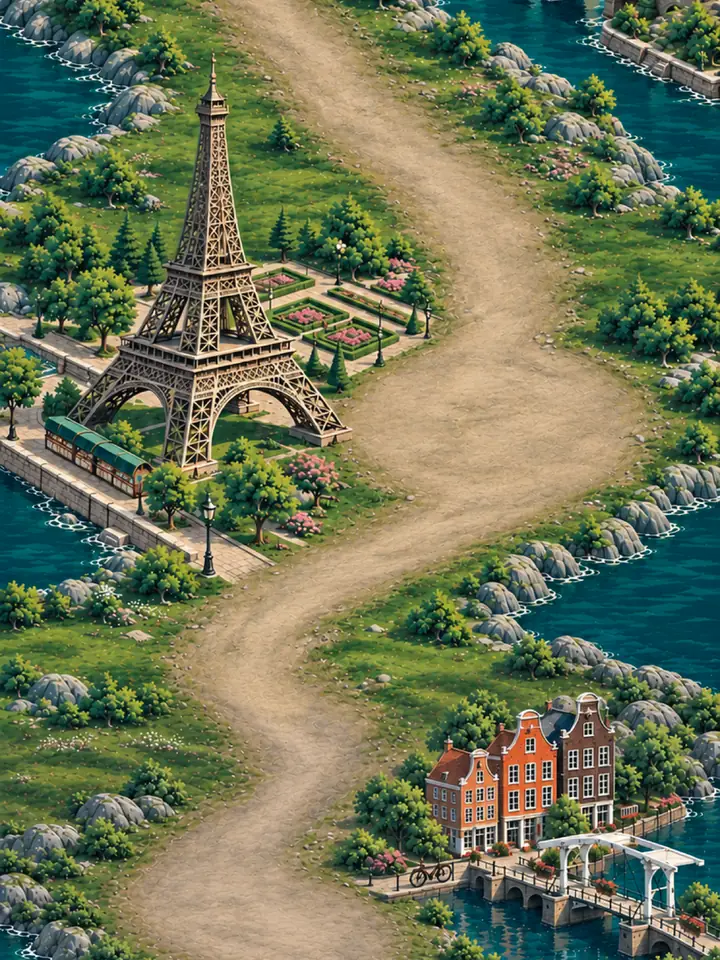
Stop 7 of 58, Europe
Paris
France · Western Europe
Paris grew from the Île de la Cité, an island in the Seine that is still the oldest part of the city. The Eiffel Tower was built for the World’s Fair of 1889 and was due to come down after 20 years. The Louvre began as a royal fortress, finished in 1202.
- Country
- France
- Region
- Western Europe
- People
- about 2 million
- Landmark
- Eiffel Tower
Try a Paris question
Where does the Loire meet the Atlantic?
The tour starts in Reykjavík.
A short history
The Parisii people lived around here from the mid-3rd century BC. In the mid-1st century BC, Julius Caesar wrote of the town as Lutetia Parisiorum, and in 52 BC he conquered the surrounding Paris Basin. In 508 Clovis I, the first Merovingian king, made Paris his capital. Work on Notre-Dame began in 1163 and took 182 years. Under Napoleon III, the prefect Haussmann added wide boulevards and parks.
Worth seeing
Gustave Eiffel’s company built the Eiffel Tower between 28 January 1887 and 31 March 1889. It joins 18,038 iron parts with 2.5 million rivets. The tower reaches 330 metres to the tip, and the full climb is 600 steps. About 60 tons of paint are put on it every seven years.
On the Île de la Cité, Notre-Dame suffered a fire on 15 April 2019. After careful rebuilding, the cathedral reopened on 7 December 2024.
Did you know?
- On a hot day, the top of the Eiffel Tower can lean up to 18 cm away from the sun.
- The Eiffel Tower was the world’s tallest structure from 1889 until 1930.
- Montmartre’s name comes from Mons Martyrum, meaning Hill of Martyrs.
Find it on the map
Look at northern central France. Paris sits on the Seine, in a north-bending arc of the river, in the middle of the Île-de-France region. The city covers about 105 square km and is split into 20 districts called arrondissements. Heights run from 28 to 131 metres.