
Stop 1 of 58, Europe
Reykjavík
Iceland · The Nordics
Reykjavík is the northernmost capital of a sovereign state. Its name means “smoky bay”, after steam rising from hot springs. In Iceland, at least nine in ten homes are heated by the earth’s own warmth. Warm water even runs under some streets to melt the snow.
- Country
- Iceland
- Region
- The Nordics
- Name means
- Smoky bay
- Heating
- Geothermal water
Try a Reykjavík question
Where is north Iceland’s whale-watching town?
The tour starts in Reykjavík.
A short history
Tradition says the first settler, Ingólfur Arnarson, arrived from Norway in the year 874 and made his home here. The city itself was officially founded much later, in 1786, as a trading town. Reykjavík was one of several towns given a charter then, and the only one that kept it for good. Today about 140,000 people live in the city. The wider capital region has around 250,000, roughly 64 percent of everyone in Iceland.
Worth seeing
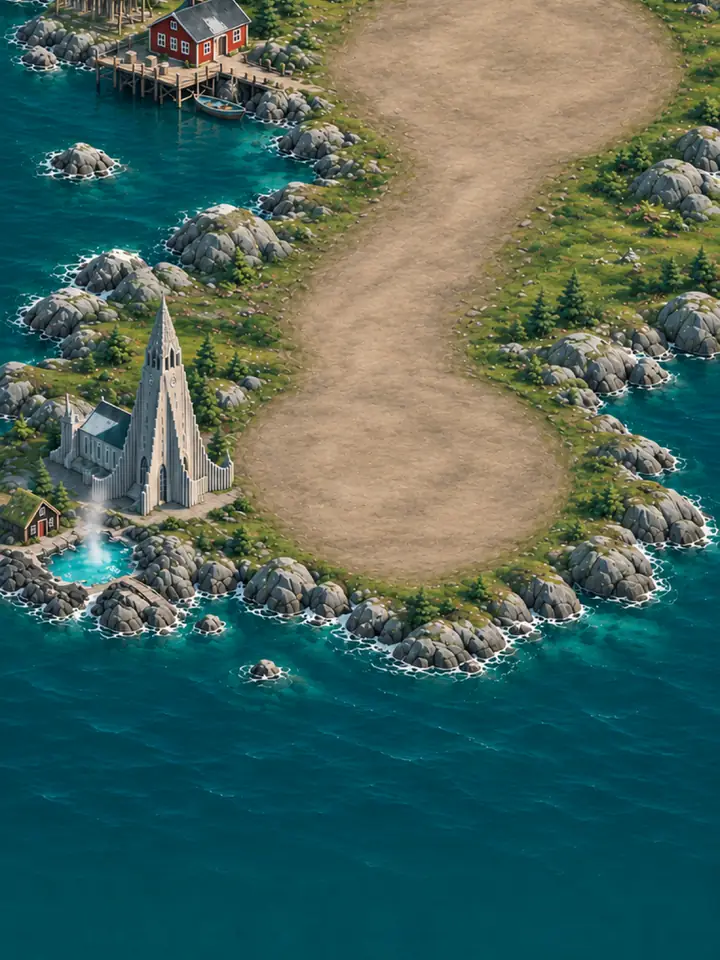
Hallgrímskirkja is the largest church in Iceland. It took 41 years to build, from 1945 to 1986. Architect Guðjón Samúelsson shaped it after Iceland’s mountains, glaciers and the columns of cooled lava called basalt. A lift takes you up the tower to a viewing deck over the city and the mountains.
Mount Esja, at 914 metres, is the highest mountain near Reykjavík. The statue of Leif Erikson is another landmark, a gift from the United States in 1930, marking 1,000 years of Iceland’s parliament.
Did you know?
- Between 2 December and 10 January, daylight lasts less than five hours.
- In those weeks the midday sun climbs only about 3 degrees above the horizon.
- Greenland’s capital Nuuk lies only slightly further north than Reykjavík.
Find it on the map
Look at the southwest of Iceland, on the southern shore of the big bay called Faxaflói. Reykjavík sits mostly on the Seltjarnarnes peninsula. Keflavík airport lies about 50 km west-southwest. Greenland’s capital Nuuk is at almost the same latitude.