
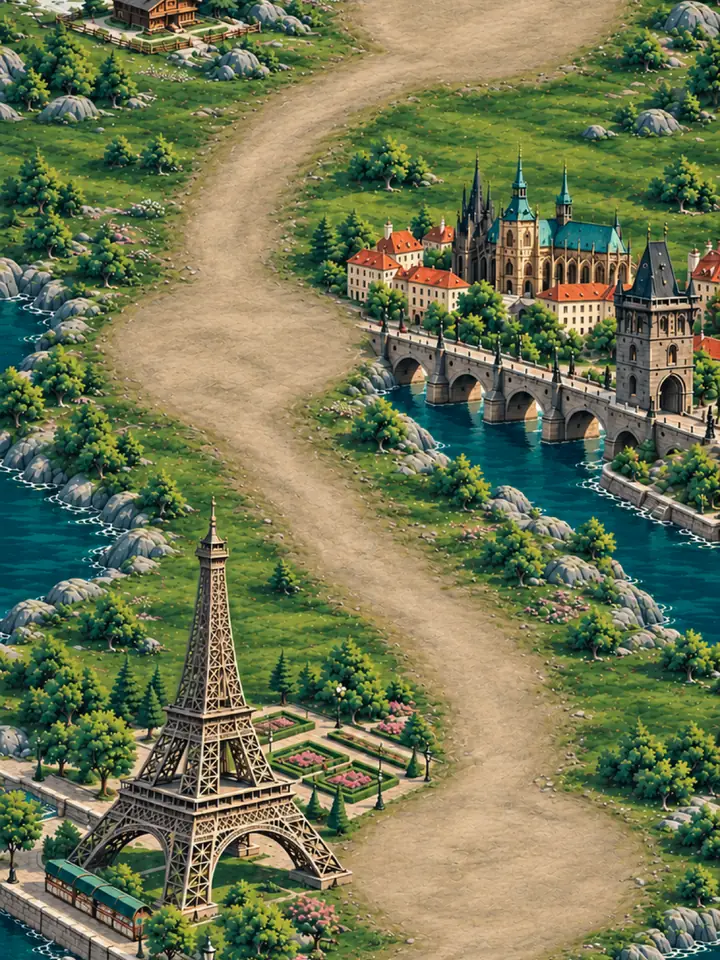
Stop 8 of 58, Europe
Prague
Czechia · Central Europe & the Alps
Prague’s astronomical clock has hung on the Old Town Hall since 1410. Charles Bridge, begun in 1357, crosses the Vltava and is lined with 30 statues. Up on the hill, Prague Castle is listed by Guinness World Records as the largest ancient castle in the world.
- Country
- Czechia
- Region
- Central Europe & the Alps
- People
- about 1.4 million
- River
- Vltava
Try a Prague question
Where is the spa town once called Karlsbad?
The tour starts in Reykjavík.
A short history
Vyšehrad, a fort in the south of the city, was founded in the 10th century. Under Charles IV, who ruled from 1346 to 1378, Prague became an imperial capital, and in 1347 he founded Charles University. In 1989 the Velvet Revolution filled the streets. Since 1992 the historic centre has been a UNESCO World Heritage Site. Prague is also the historic capital of Bohemia.
Worth seeing
The astronomical clock, the Orloj, hangs on the southern wall of the Old Town Hall in Old Town Square. Its main dial works like a mechanical astrolabe and shows the positions of the Sun and Moon. Every hour on the hour, figures of the Apostles move past two little doors above it. A calendar dial below shows a church calendar with 365 saints.
Petřín is a hill in the city centre, 327 metres high.
Did you know?
- The City of a Hundred Spires got its nickname from a 19th-century count. Today about 500 spires are estimated.
- The Orloj shows four kinds of time, including old Czech time and sidereal time.
- Prague lies at about the same latitude as Frankfurt in Germany.
Find it on the map
Find the Czech Republic, in the historic region of Bohemia. Prague sits on the Vltava river, at about the same latitude as Frankfurt, Germany. The Berounka flows into the Vltava in the suburb of Lahovice. In the north, the city reaches into the Central Elbe Table lowland.