
Stop 25 of 58, Asia
Samarkand
Uzbekistan · Central & South Asia
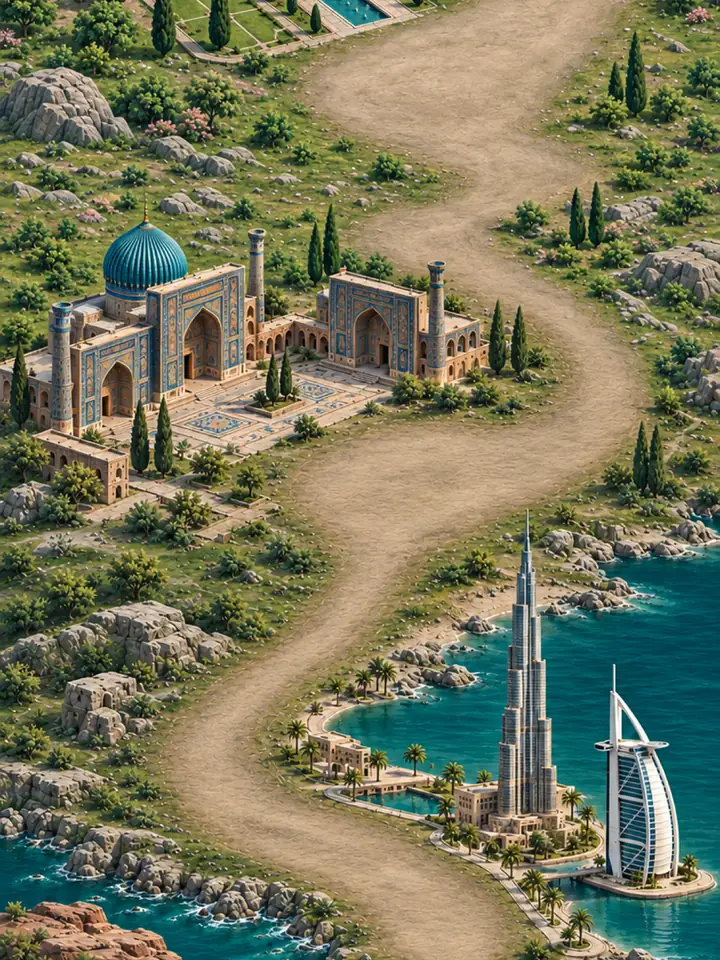
Samarkand grew rich on the Silk Road between China, Persia and Europe. Its showpiece is the Registan, a square framed by an ensemble of three grand madrasas. In 1370 the conqueror Timur made it his capital. Today it is on UNESCO’s list as a crossroads of cultures.
- Country
- Uzbekistan
- Region
- Central & South Asia
- Showpiece
- The Registan
- Route
- Silk Road
Try a Samarkand question
Where is the walled old town of Khiva?
The tour starts in Reykjavík.
A short history
Researchers date the founding of Samarkand to around 700 BC. Signs of human activity go back about 40,000 years. Alexander the Great conquered the city, then called Marakanda, in 329 BC. Arab armies captured it around 712 AD. Genghis Khan took it in 1220, and the city was pillaged. Legend says Chinese prisoners from the Battle of Talas in 751 passed on the secret of paper, leading to the first paper mill in the Islamic world here.
Worth seeing
The Registan has three madrasas. The Ulugh Beg Madrasa dates from 1417 to 1420, the Sherdar from 1619 to 1636 and the Tilakari from 1646 to 1660. The Sherdar has tiger mosaics with a rising sun on their backs. Tilakari means the Gilded Madrasa, and its mosque hall is richly gilded.
Ulugh Beg also built an observatory in 1428. The Bibi-Khanym Mosque was built between 1399 and 1404. The Shah-i-Zinda memorial complex was founded by Qarakhanid rulers in the 11th century.
Did you know?
- Registan comes from a Persian word that means place of sand.
- Royal proclamations at the Registan were announced on enormous copper pipes called dzharchis.
- Ulugh Beg’s giant sextant had a radius of 40 metres.
Find it on the map
Find south-eastern Uzbekistan, in the valley of the Zeravshan River. Samarkand sits at 705 metres above sea level. By road it is about 270 km from Tashkent and 240 km from Bukhara. It is the second-largest city in Uzbekistan.