
Stop 34 of 58, Asia
Mount Fuji
Japan · the last stop in Asia
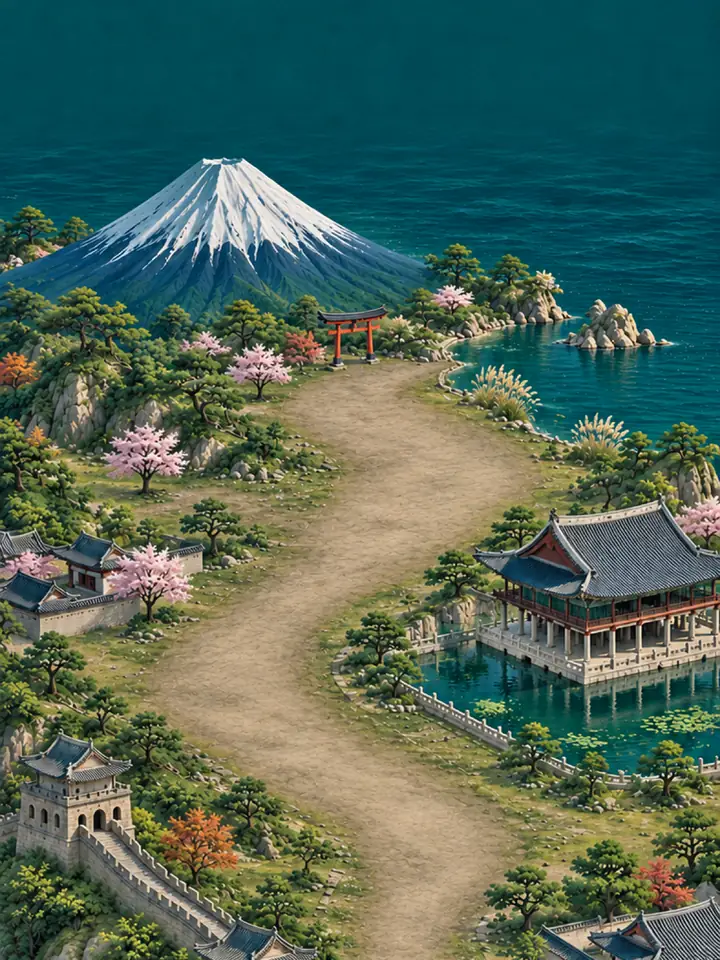
Mount Fuji is Japan’s highest mountain, at 3,776 metres. It is an active volcano that last erupted in 1707 and 1708. Hokusai painted it again and again in his famous Views of Mount Fuji. Most Japanese climbers go up at night to be near the top when the sun rises.
- Country
- Japan
- Region
- East Asia
- Height
- 3,776 m
- Last eruption
- 1707–1708
Try a Mount Fuji question
Where is Japan’s thousand-year capital?
The tour starts in Reykjavík.
A short history
Geologists think an older volcano, Old Fuji, formed about 100,000 years ago. The modern cone, New Fuji, grew on top of it around 10,000 years ago. People have long climbed Fuji, and tradition credits En no Odzunu with the first ascent in 663. Tatsu Takayama is the first woman on record to reach the top, in autumn 1832. UNESCO listed Fuji as a cultural site in 2013.
Worth seeing
Five lakes lie around the mountain: Kawaguchi, Yamanaka, Sai, Motosu and Shoji.
The main climbing season is July and August, and buses to the trailheads start on 1 July. Climbing from October to May is discouraged. In 2009, about 300,000 people climbed Fuji.
Did you know?
- Fuji’s cone is exceptionally symmetrical.
- The mountain is snow-covered for about five months of the year.
- In 2024 the first snowcap came on 6 November, the latest since records began in 1894.
Find it on the map
Find Honshu, Japan’s main island, then look about 100 km southwest of Tokyo. Fuji straddles two prefectures, Shizuoka and Yamanashi. Five lakes surround the mountain.