
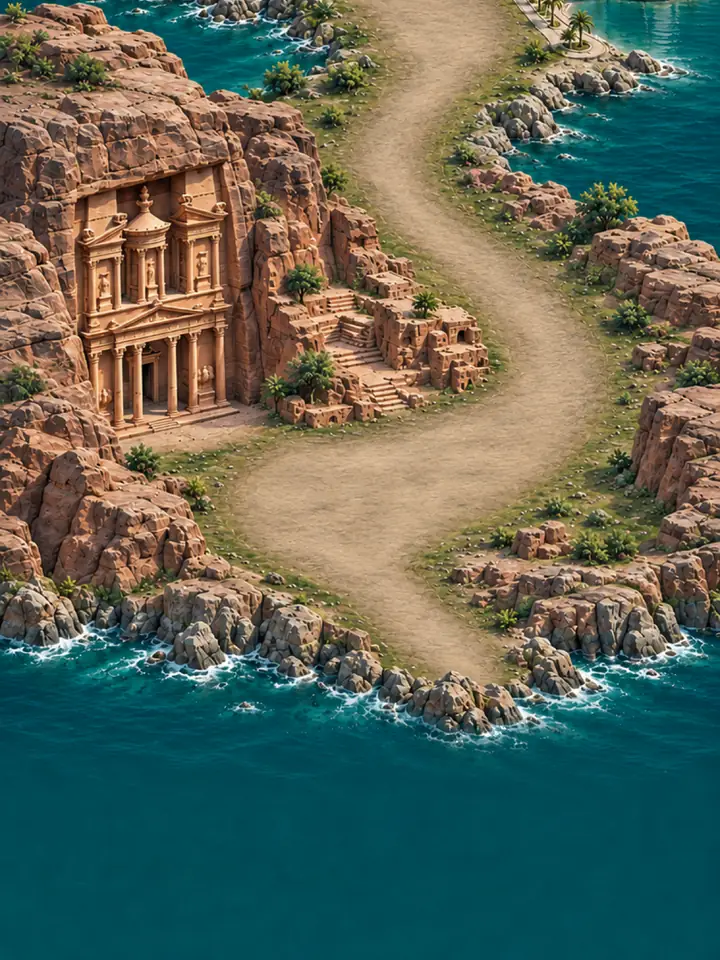
Stop 23 of 58, Asia
Petra
Jordan · Middle East
Petra was carved into sandstone cliffs by the Nabataeans, who made it their capital in the 2nd century BC. The colour of the stone gives it the nickname “the Rose City”. Most visitors still arrive through the Siq, a dark, narrow gorge that ends at the Treasury.
- Country
- Jordan
- Region
- Middle East
- Built by
- The Nabataeans
- World Heritage
- Since 1985
Try a Petra question
Where can you float in water far saltier than the ocean?
The tour starts in Reykjavík.
A short history
Nabataea fell to the Romans in 106 AD, who annexed it and renamed it Arabia Petraea. The earthquake of 363 destroyed many buildings and crippled the water system the Nabataeans had built. Petra then stayed unknown to the western world until 1812, when the Swiss traveller Johann Ludwig Burckhardt rediscovered it. In 1845 the poet John William Burgon called it a rose-red city half as old as time.
Worth seeing
The Siq is a gorge only three to four metres wide in places. It acts as a waterway that flows into the Wadi Musa. At its end stands the Treasury, called Al-Khazneh, which is 37 metres tall and 24 metres wide.
For a second big front, climb to the Monastery, Ad Deir. It is 45 metres tall and 50 metres wide, wider than the Treasury. A separate walk of about 800 steps leads to the High Place of Sacrifice.
Did you know?
- The Nabataeans used dams, cisterns and channels to control flash floods and store water through droughts.
- In 2007 a popular poll named Petra one of the New 7 Wonders of the World.
- Petra appeared in the film Indiana Jones and the Last Crusade.
Find it on the map
Look at southern Jordan, in Ma’an Governorate. Petra sits on the eastern side of the Arabah valley, which runs from the Dead Sea down to the Gulf of Aqaba. The site lies at the head of the Wadi Musa valley.