
Stop 29 of 58, Asia
Angkor
Cambodia · Southeast Asia
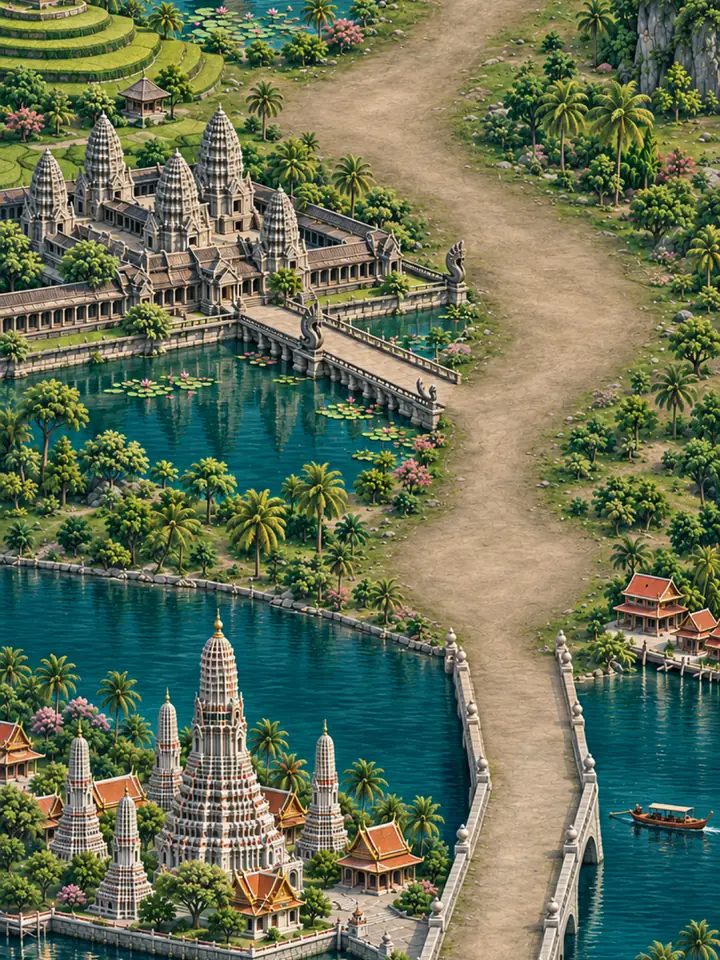
Angkor was the capital of the Khmer Empire, which flourished from about the 9th to the 15th century. Angkor Wat was built in the first half of the 12th century. Guinness World Records counts it as the largest religious structure in the world. It has been on Cambodia’s flag since 1863.
- Country
- Cambodia
- Region
- Southeast Asia
- World Heritage
- Since 1992
- Flag
- Angkor Wat
Try a Angkor question
Where is the lake whose river flows backwards each year?
The tour starts in Reykjavík.
A short history
In 802 AD Jayavarman II declared himself universal monarch and god-king. From 889 Yasovarman I built the city of Yasodharapura around Phnom Bakheng, with a massive reservoir called a baray. In 1181 Jayavarman VII took the throne and built Angkor Thom over the old city. In 1431 Ayutthaya sacked Angkor, and many people moved south to Longvek. Nearly all of Angkor was then abandoned, except Angkor Wat, which stayed a Buddhist shrine.
Worth seeing
Angkor Wat’s central tower is 65 metres high, in a group of five towers shaped like lotus buds. Unlike most Angkor temples, it faces west. A moat about 190 metres wide surrounds it, and the walls carry scenes from the Ramayana and Mahabharata.
In Angkor Thom, the Bayon’s face towers show the king as the bodhisattva Avalokiteshvara. Ta Prohm was dedicated to the king’s parents. A stone carving there records that 12,640 people served that one temple complex.
Did you know?
- A 2007 study called Angkor the largest pre-industrial city in the world by area, at least 1,000 square kilometres.
- The main tower of Angkor Wat lines up with the sunrise of the spring equinox.
- Stone for Angkor Wat reportedly came from the Mount Kulen quarry, about 40 km north-east.
Find it on the map
Look in Siem Reap Province, in Cambodia. The ruins lie among forests and farmland north of Tonlé Sap, the Great Lake, and south of the Kulen Hills. The archaeological park covers about 400 square kilometres.