
Stop 44 of 58, South America
Rio de Janeiro
Brazil · Amazon & Brazil
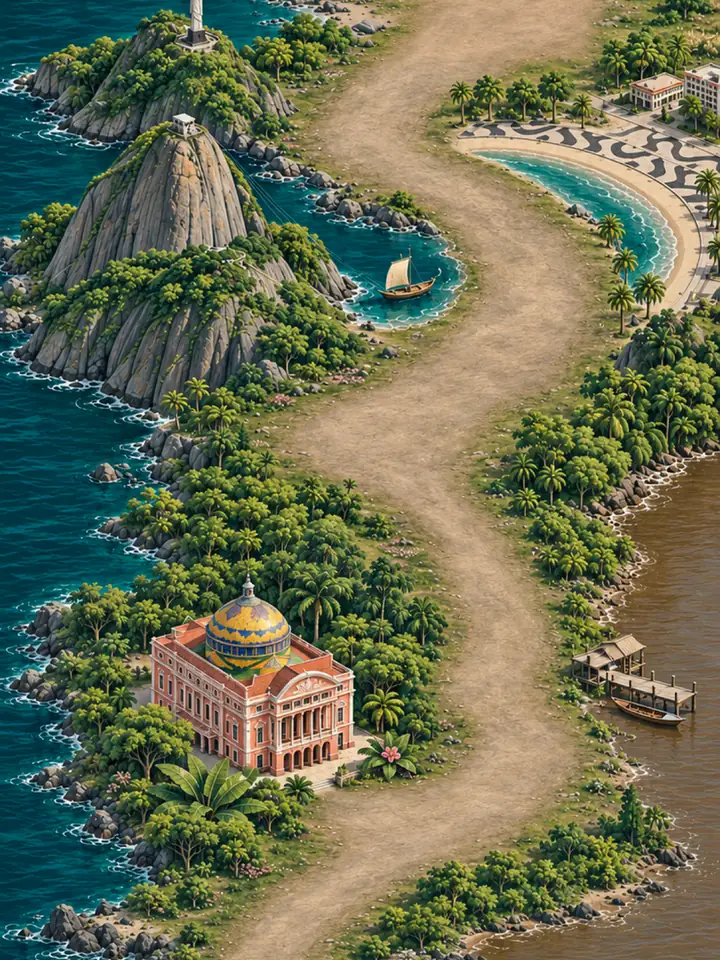
Rio de Janeiro means “River of January”: Europeans first reached Guanabara Bay on 1 January 1502. The statue of Christ the Redeemer stands on top of Corcovado mountain. Sugarloaf Mountain marks the entrance to the bay. Rio is Brazil’s second-largest city.
- Country
- Brazil
- Region
- Amazon & Brazil
- Name means
- River of January
- Statue
- Christ the Redeemer
Try a Rio de Janeiro question
Where is Brazil’s biggest city?
The tour starts in Reykjavík.
A short history
The Portuguese founded Rio on 1 March 1565. In 1763 it became the capital of the State of Brazil. It stayed the capital of the Empire of Brazil and then of the republic, until the capital moved to Brasília in 1960. Locals still call it Cidade Maravilhosa, the Marvelous City. In 2016 Rio hosted the Summer Olympics, the first city in South America and the first Portuguese-speaking city to do so.
Worth seeing
Christ the Redeemer stands about 30 metres tall on an 8-metre pedestal, with arms stretched 28 metres wide. It was built from reinforced concrete covered in soapstone and opened on 12 October 1931. The mountain under it, Corcovado, is about 700 metres high.
Sugarloaf Mountain rises 396 metres above the harbour. Two cable cars take you up. The first stops at the lower hill, Morro da Urca, and the second goes on to the summit. The cableway opened in 1912 and was the first in Brazil.
Did you know?
- Lightning struck Christ the Redeemer during a thunderstorm on 10 February 2008.
- Sugarloaf is named after the cone-shaped moulds in which refined sugar was once pressed.
- More than 130 islands dot Guanabara Bay.
Find it on the map
Find the Atlantic coast of Brazil. Rio sits on the western shore of Guanabara Bay, which opens to the sea through a mouth only 1.5 km wide. Sugarloaf guards that entrance. Across the bay lie Niterói and São Gonçalo, joined to Rio by a 13.29 km bridge.