
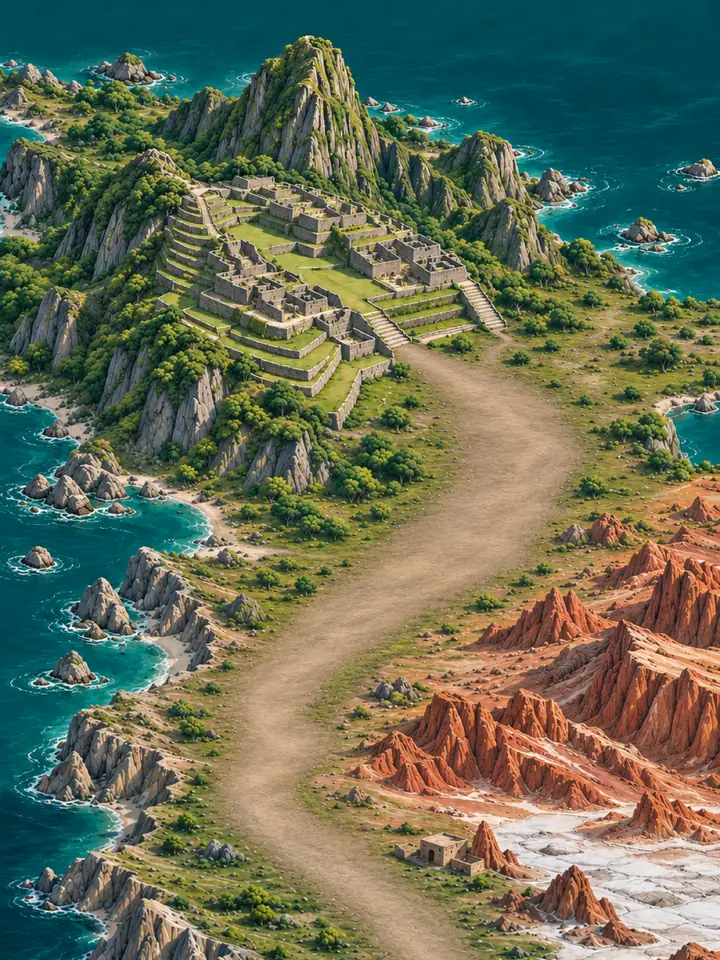
Stop 48 of 58, South America
Machu Picchu
Peru · the last stop in South America
Machu Picchu is a 15th-century Inca citadel on a mountain ridge above a bend of the Urubamba river. Overgrown by forest, it was little known outside the area until Hiram Bingham brought it to world attention in 1911. Its finest walls are dry stone, fitted without mortar.
- Country
- Peru
- Region
- The Andes
- Built
- 15th century
- Altitude
- about 2,430 m
Try a Machu Picchu question
Where is a giant hummingbird drawn into the desert floor?
The tour starts in Reykjavík.
A short history
Machu Picchu is believed to have been an estate of the Inca emperor Pachacuti, though no written records from that time confirm it. It was abandoned roughly a century after it was built, likely during the Spanish conquest. In 1981 Peru declared the area a Historic Sanctuary. UNESCO added Machu Picchu to the World Heritage List in 1983, and in 2007 it was named one of the New Seven Wonders of the World.
Worth seeing
The Intihuatana is a carved ritual stone. Its Quechua name means roughly “place where the sun is tied”. Experts still debate what it was used for.
In the upper town stands the Temple of the Sun, also called the Torreón. This semicircular building may have been used as an observatory. Farming terraces cover about 4.9 hectares, a reminder that the Incas grew food on steep slopes.
Did you know?
- About 200 buildings are arranged on the terraces.
- Peru’s Historic Sanctuary around the site covers 325.92 square kilometres.
- The complex may originally have been called Huayna Picchu, the name of the smaller peak beside it.
Find it on the map
Find southern Peru and the Cusco Region. Machu Picchu is about 80 km northwest of the city of Cusco, in Urubamba Province. It sits on a saddle between two peaks, Huayna Picchu and Machu Picchu mountain. The town of Aguas Calientes lies in the valley below.