
Stop 46 of 58, South America
Patagonia
Argentina · Southern Cone
Patagonia covers the southern end of South America and is governed by Argentina and Chile. Westerly winds sweep across its plains, and some towns are among the windiest places on Earth. In 1865, 153 Welsh settlers landed here from the ship Mimosa, and Welsh is still spoken in places.
- Country
- Argentina
- Region
- Southern Cone
- Shared by
- Argentina and Chile
- Settlers
- Welsh, from 1865
Try a Patagonia question
Where is the cape where the Atlantic and Pacific meet?
The tour starts in Reykjavík.
A short history
The name Patagonia comes from the word patagón. Magellan used that word in 1520 to describe the native tribes he met in the region. Today Argentina holds about 800,000 square kilometres of Patagonia, and Chile holds about 308,000. Together that is a little more than a million square kilometres, much of it steppe-like plains that stretch away to the horizon.
Worth seeing
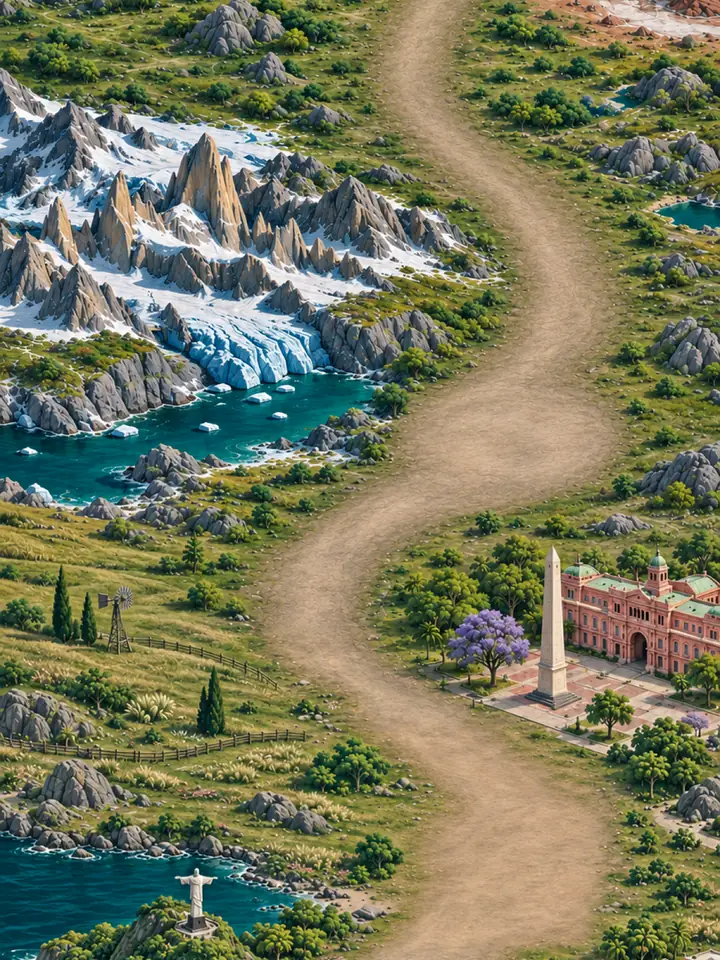
Perito Moreno Glacier is about 30 kilometres long and covers 250 square kilometres. Its ice wall rises around 74 metres above the lake it flows into, Lago Argentino. It sits in Los Glaciares National Park, in Santa Cruz Province. Every so often the ice dams the lake, and the pressure finally breaks it open.
Across the border in Chile, Torres del Paine National Park shows three sharp granite peaks, the Towers, rising about 2,500 metres. Guanacos are among the most common animals you will meet there.
Did you know?
- Paine Grande, the highest peak of the Paine massif, was measured by GPS in 2011 at 2,884 metres.
- The ice dam at Perito Moreno breaks about once a year at most, and sometimes less than once a decade.
- Tierra del Fuego, the island group at the tip, is often counted as part of Patagonia.
Find it on the map
Look at the southern end of South America, where the Andes run down the west side. The Strait of Magellan links the Pacific and the Atlantic here. The Colorado river is commonly taken as the northern edge of Argentine Patagonia. Tierra del Fuego lies at the very bottom.