
Stop 42 of 58, South America
Galápagos
Ecuador · Caribbean coast & islands
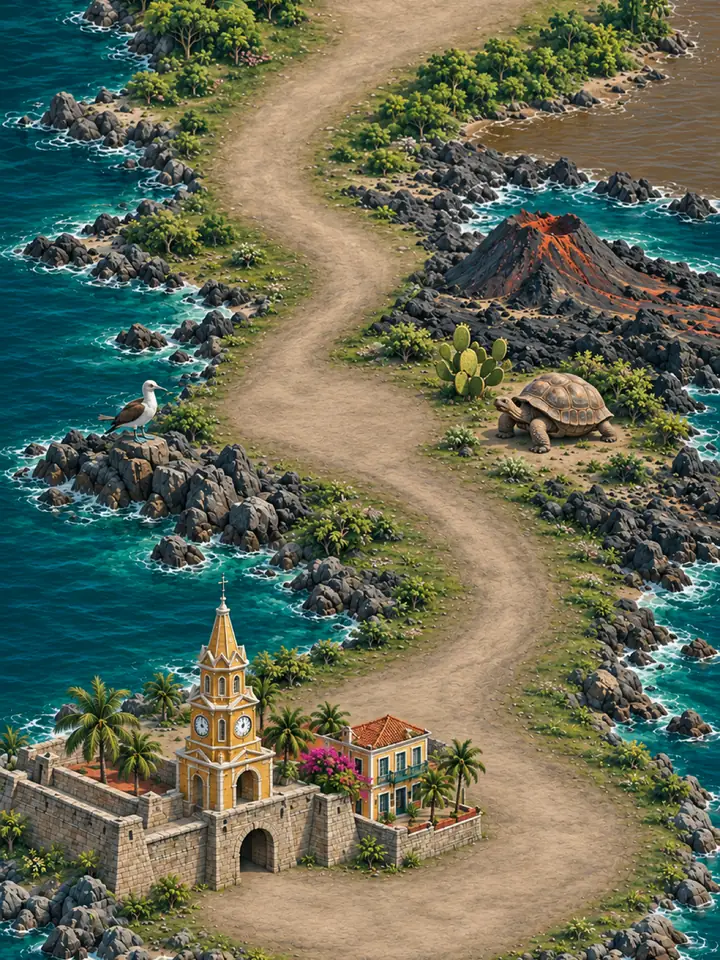
The Galápagos Islands lie about 900 km west of mainland South America and straddle the equator. Charles Darwin studied their unique wildlife in the 1830s, and it inspired his theory of evolution. The islands are named after the giant tortoises that live on them.
- Country
- Ecuador
- Region
- Caribbean coast & islands
- Distance
- about 900 km offshore
- Famous visitor
- Charles Darwin, 1830s
Try a Galápagos question
Where is the capital that sits almost on the equator in the Andes?
The tour starts in Reykjavík.
A short history
European discovery of the islands is recorded on 10 March 1535, credited to Bishop Tomas de Berlanga. Charles Darwin studied the islands’ species in the 1830s. UNESCO made the islands a World Heritage Site in 1978, in its second session. Today they form the Galapagos Province of Ecuador, and all of the islands are protected as part of a national park and marine reserve.
Worth seeing
Santa Cruz lies in the centre of the archipelago and covers 986 square kilometres. The Charles Darwin Research Station is there. It was the home of Lonesome George, the last known Pinta Island giant tortoise, found in 1971.
Isabela is the largest island by far, at 4,588 square kilometres. That is close to three-fifths of all the land in the archipelago.
Did you know?
- The Galapagos have 127 islands, islets and rocks. Only 19 are large, bigger than 1 square kilometre.
- The nine active volcanoes erupted 24 times between 1961 and 2011.
- Lonesome George died on 24 June 2012, at around 100 years old.
Find it on the map
Look in the Pacific Ocean, west of Ecuador. The islands belong to Ecuador and sit on top of the Galapagos hotspot, where volcanoes rise from the sea floor. Isabela is the biggest island, and Santa Cruz lies in the middle of the group. The cold Humboldt Current brings frequent drizzle.