
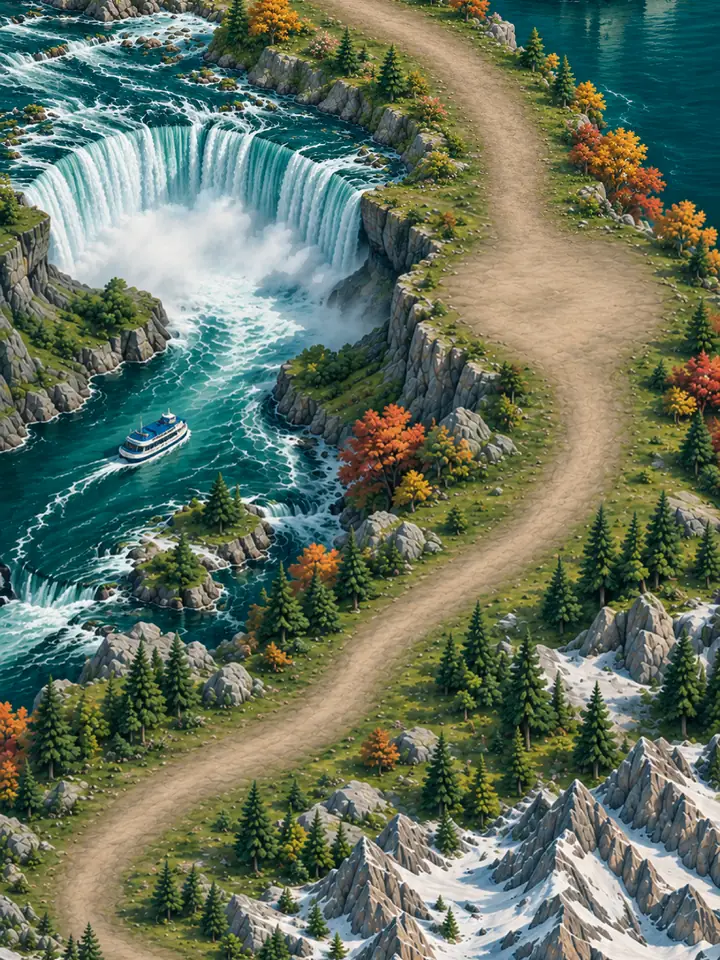
Stop 57 of 58, North America
Niagara Falls
Canada · East Coast
Niagara Falls is three waterfalls on the Niagara River, which flows from Lake Erie to Lake Ontario. The biggest, Horseshoe Falls, lies mostly in Canada. A 1950 treaty lets more water be diverted for power at night and in winter, when fewer people come to look.
- Country
- Canada
- Region
- East Coast
- Waterfalls
- Three
- Biggest
- Horseshoe Falls
Try a Niagara Falls question
Where do the Thousand Islands dot a river?
The tour starts in Reykjavík.
A short history
The falls were shaped by the Wisconsin glaciation, about 10,000 years ago. Since then the water has been wearing the rock away. In the past the falls moved upstream by 1 to 1.5 metres a year. Today it is about 30 centimetres. The name comes from a Native American word, Ongiara, said to mean “thundering water”, although other origins have been suggested. In 1859 Charles Blondin crossed the gorge on a tightrope, and he did it eight more times that year.
Worth seeing
Horseshoe Falls is about 790 metres wide at the crest. It lies on the western side of Goat Island. On the other side of the island, American Falls and the small Bridal Veil Falls drop in the United States.
The falls sit at the southern end of the Niagara Gorge. The river has cut this gorge through a cliff of the Niagara Escarpment.
Did you know?
- At peak daytime hours, more than 168,000 cubic metres of water go over the crest every minute.
- In June 1969, a temporary dam of rock and earth diverted the river from American Falls for several months.
- Niagara is still the biggest electricity producer in New York state, with a capacity of 2.4 gigawatts.
Find it on the map
Find the Niagara River, which links Lake Erie with Lake Ontario. The falls lie on the border between Ontario in Canada and New York in the United States. They are about 27 km northwest of Buffalo and about 69 km southeast of Toronto.