
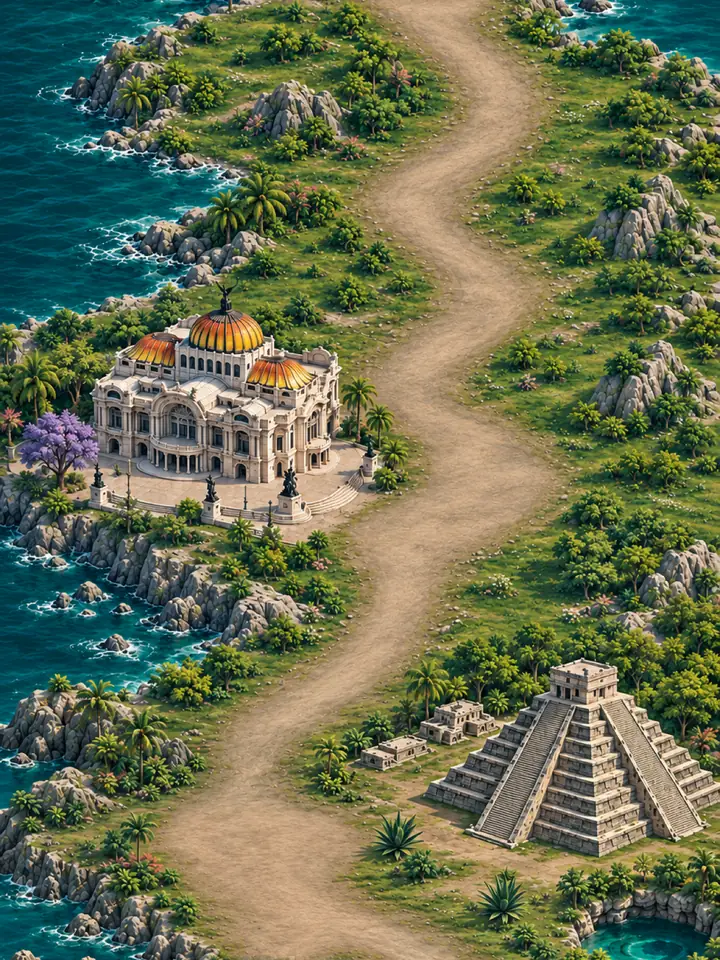
Stop 51 of 58, North America
Mexico City
Mexico · Mexico & Central America
Mexico City began as Tenochtitlan, built around 1325 on islands in Lake Texcoco. The old lakebed is soft clay, and parts of the city sink by around 50 cm a year. It sits at 2,240 metres. Flat-bottomed boats called trajineras still glide along the canals of Xochimilco.
- Country
- Mexico
- Region
- Mexico & Central America
- People
- about 9.2 million
- Altitude
- 2,240 m
Try a Mexico City question
Where did the Olmecs carve giant stone heads?
The tour starts in Reykjavík.
A short history
Hernán Cortés arrived in Tenochtitlan on 8 November 1519. The Aztec leader Cuauhtémoc surrendered in August 1521, and the Spaniards practically razed the city during the final siege. They built a new one on the ruins. The Metropolitan Cathedral rose over the remains of the main Aztec temple, and its construction took from 1571 to 1813. From the 17th century, Lake Texcoco was drained.
Worth seeing
The Templo Mayor was the main Aztec temple. It was dedicated to two gods at once: Huitzilopochtli, god of war, and Tlaloc, god of rain and farming. Electricity workers found the carved Coyolxauhqui stone here on 21 February 1978. The stone disk is more than 3.25 metres across. The temple was rebuilt six times after the first version.
In Xochimilco, in the south of the city, about 170 km of canals wind between artificial islands called chinampas. One of them is the Island of the Dolls.
Did you know?
- The axolotl, the best-known animal of Xochimilco’s waters, was once seen as an incarnation of the god Xolotl.
- Xochimilco comes from a Nahuatl word meaning “flower field”.
- The historic centre and Xochimilco were named a UNESCO World Heritage Site in 1987.
Find it on the map
Look for the Valley of Mexico, surrounded by mountains and volcanoes that rise over 5,000 metres. The city fills the valley. The old centre grew around the main square, the Zócalo. Xochimilco lies in the southeastern part. Greater Mexico City had about 21.8 million people in 2020.